VSCOM announces the release of an upgraded ARM 9 RISC embedded industrial computer -
OpenRISC Alekto LAN with 2 Ethernet
ports and an integrated Ethernet Switch. This model is a further member of the OpenRISC family. Like the initial
Alekto
it is based on an ARM9 RISC CPU and runs the full-featured Debian GNU/Linux operating system, now with Kernel 2.6.35.
To learn more about the OpenRISC family, please check out the older
news announcements. Further the
product
pages provide much information.
As with all the Alekto and Alena models Debian GNU/Linux is available as operating system. Vision Systems provides a sample
installation of this operating system, an image prepared for a Compact Flash or microSD card. This software also operates
without changes on the Alekto LAN, as do existing customer applications for Alekto.
So Alekto LAN is suitable to cover the same control and networking applications for industrial control,
transportation systems, environmental monitoring and small office servers.
However the second Ethernet interface is internally connected to an embedded Ethernet switching hub. So Alekto LAN is
predestined for more special networking tasks. It can span a small local network, while the first port provides as an
uplink to data servers or the company network in general.
Router Application
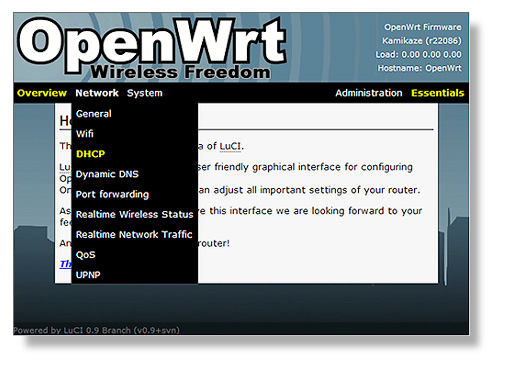
The special networking capabilities make the Alekto LAN a good base for a Router implementation. Vision Systems decided for
OpenWrt as the software to make the Alekto LAN a Router. OpenWrt is not only a Router software, in fact it is a complete
system for users to build their own Router firmware. To do this there is the base system and a collection of packages to
install. Vision Systems added support of Alekto to OpenWrt.
Usually OpenWrt is installed by end users onto the Flash memory of their SOHO Routers. That capacity is limited, typically
to 8?MB or less. But on Alekto LAN the software is installed on mass storage, where practically no size limit exists.
So users are free to add as many packages as they like or need.
VSCOM selected several of the the OpenWrt system packages to prepare an installation. The result is available as a
complete image on the DVD. Users can write it to a CF card, boot it and use it. System developers may use it as a starting
point for their own software, which they distribute with Alekto LAN.
Here is a list of the implemented features:
Hardware
- Wireless LAN (AP and Client Mode)
OpenWrt supports a WLM54G MiniPCI network adapter (based on Atheros AR2413). Placed in the internal slot Alekto LAN can
operate as an Access Point to span a WLAN radio network for clients. It is also possible to use WLAN to connect Alekto LAN
to other networks.
- Digital Inputs/Outputs (Controllable via Webinterface)
As all the other brother models Alekto LAN supports 8 signals for Digital-I/O function. This implementation of OpenWrt
provides a web-based user interface to control the direction of the signals, define the output and read the input.
There is also a direct TCP interface to use this function from client software.
- 2 USB host ports
The implementation allows to add external mass storage (e.g. HDD), making Alekto LAN operating as a NAS. All types of USB
devices may be used, provided there is support for them in OpenWrt.
Services
- File Server (Samba/NFS)
Alekto LAN provides an internal slot for a microSD storage card. Combined with the CF slot (and external storage on USB)
the available capacity is provided via Samba (for Windows clients) and NFS (for Unix/Linux clients.)
- Print Server
for printers connected to USB or even the serial port.
- OpenVPN (Server and Client)
OpenVPN is a free and open source software, providing encrypted Virtual Private Network functions over any network based on IP.
The Server component allows to establish a secure encrypted connection from a Client PC to Alekto LAN. This is especially
possible from the Internet, virtually connecting the Client to the internal LAN.
Operating as a Client securely connects Alekto LAN to a central server. This way computers in a branch office get secure
access to the headquarters network, without purchasing a dedicated line.
- Dynamic DNS
Dynamic DNS services provide an easy name to stations using an Internet connection with periodically changing IP address.
OpenWrt supports several free (for private users) services, to automatically update the DDNS information, when the public
IP address has changed. There is a good chance to support a new service by updating the scripts in OpenWrt.
- Proxy Server
The OpenWrt implementation provides a proxy server for clients on the LAN side.
- UPnP
OpenWrt also supports UPnP, this enables clients to access the configuration of the Router.
In particular certain software on the clients can make its network service available to the Internet, by defining a special
tunnel to forward the external traffic to the client.
Networking
- SSH
Encrypted access to the command line of OpenWrt. May be used for certain configuration, or just monitoring the operation.
- Firewall
Since OpenWrt transports the IP traffic from and to the Clients, it can also monitor the content. Doing this it attempts
to protect the clients from certain types of malicious packages.
- QoS
OpenWrt provides features to set priority to certain types of traffic. This will help some applications to perform better.
- DHCP
For the LAN (and WLAN) clients OpenWrt operates as a DHCP server. Clients get a correct IP address for the network, and also
other configuration information to get access to the Internet.
For WAN access OpenWrt can request and receive a suitable configuration of the public interface. This function is often
required for an ISP based on TV cable services, but of course not restricted to this.
- Traffic Analysis/Graphs
OpenWrt provides information to the Administrator, so he can check the type of traffic occurring from and to the Internet.
This will help to tune the configuration for better performance.




